

Loomi recommendation templates
Loomi templates use machine learning models to generate recommendations. They require training time—algorithms are usually run overnight so the model is ready the next day.
Choose a Loomi template for recommendations based on similarity suggestions, co-occurrence patterns, and more—and when your catalog has enough historical data to train the model. If your catalog is new or sparse, start with a ready to use template instead.
PersonalizationMost Loomi templates offer personalization based on selected customer events. The following templates are not personalized:
Loomi templates quick overview
The following templates are supported by Loomi:
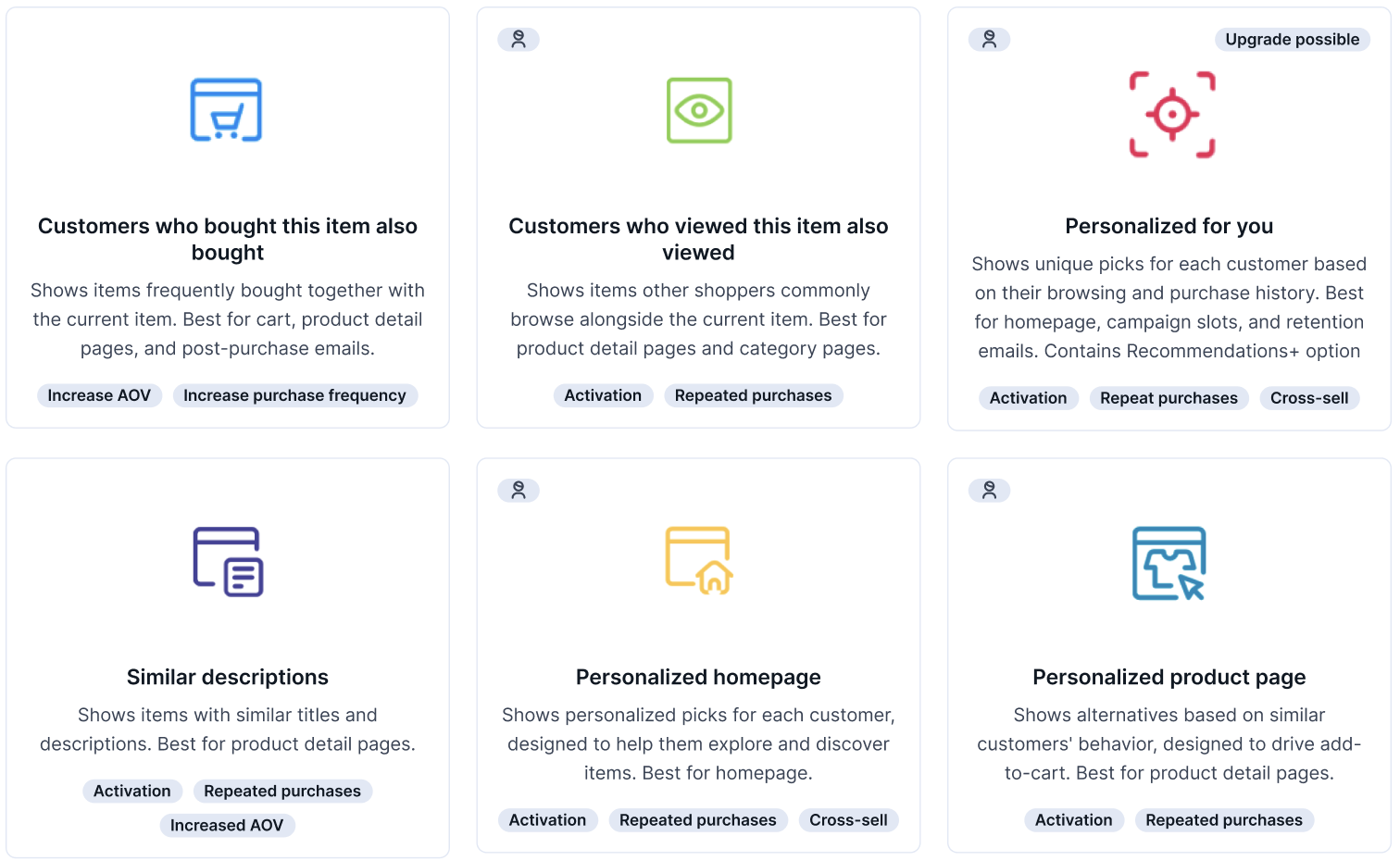
| Template | Use it for |
|---|---|
| Customers who bought this item also bought | "Frequently bought together" blocks used for cross-sell on product detail and cart pages. |
| Customers who viewed this item also viewed | "You might also like" blocks on product detail pages, based on co-viewed patterns. |
| Personalized for you (History-based) (previously Personalized recommendations for you) | Personalized recommendations blocks across any placement—homepage, email, cart, or post-checkout. |
| Personalized for you (Journey-based) | Personalized recommendations blocks that also use the sequence of a customer’s interactions to generate recommendations. A sequence-aware variant of the standard Personalized for you template available via the Recommendations+ add-on. |
| Similar descriptions (previously Textual similarity) | Recommendations blocks for content-heavy catalogs—media, books, apparel—where product descriptions, titles, and tags are the strongest signal for what's similar. |
| Personalized homepage (previously Homepage) | Personalized homepage block optimized for users arriving without a browsing history in the current session, for example, returning customers. |
| Personalized product page (previously Product detail) | Personalized "recommended for you" block next to the currently viewed product generated by blending item context with the customer's personal history for more relevant suggestions. |
All Loomi templates support these optional merchandising operations:
- Block list: exclude items by event or item ID
- Pin items: reserve fixed positions for specific items or attribute matches
- Dynamic filters (support varies per template): narrow the item set based on the customer or the reference item
- Customer preferences: sorts results by per-customer attribute preferences
NoteEach template uses a single engine. To combine multiple engines to cover your business needs, use the Combined ready-to-use template.
Customers who bought this item also bought
Customers who bought this item also bought is a non-personalized template used for up-sell and cross-sell on the product detail page or cart page, and in reactivation emails. It shows items frequently bought together with the item the customer is currently viewing.
| Personalized | Item-based |
|---|---|
| Recommended placement | Product detail page, cart, checkout, customer re-engagement email |
Configuration
| Required configuration | Catalog, learning window |
|---|---|
| Required events | Purchase item event |
| Dynamic filters (optional configuration) | Only item context dynamic filter supported |
| Request parameters | items (recommended); last added item (for cart use cases) |
| Data prerequisites | Recommended at least 6 months of purchase_item data |
| Fallback logic | Reference items have low purchase volume or no reference item → falls back to Popular right now. No results → falls back to random. |
NoteFor shopping cart use cases, include the ID of the item added to the cart so the engine renders recommendations based on the customer's last actions.
Example use cases
- Product detail page: show "frequently bought together" pairings on a coffee machine page—surface filters, descaler, and spare parts that other buyers added to their order
- Cart: suggest complementary items in the cart drawer when a shopper adds a DSLR camera—recommend a memory card, camera bag, or lens
- Checkout: prompt a last-minute add-on at checkout when a customer is buying running shoes—recommend socks, insoles, or a shoe bag
- Reactivation email: remind a lapsed customer what others bought alongside a product they purchased months ago to prompt a repeat visit
Customers who viewed this item also viewed
Customers who viewed this item also viewed is a personalized template used for alternative product placements like "You might also like these" on product detail pages. It shows co-viewing patterns of the item currently viewed.
| Personalized | Yes, based on items with customer history fallback |
|---|---|
| Recommended placement | Product detail page (“You might also like”) |
Configuration
| Required configuration | Catalog, learning window |
|---|---|
| Required events | Detail view event |
| Dynamic filters (optional configuration) | Supported |
| Request parameters | items (optional, when none provided, last 3 viewed are used) |
| Data prerequisites | Recommended at least 2 months of view_item data |
Fallback logic
- Reference item is included, but history is insufficient → falls back to most viewed products.
- No reference item is included → uses the customer's last 3 viewed items as the basis.
- No reference item and no view history is provided → falls back to most viewed products, then random.
Example use cases
- Product detail page: surface alternative jackets other shoppers looked at after viewing the same parka a customer is currently browsing
- Post-purchase email: show what other customers explored after buying the same item—useful for accessories or complementary categories the customer hasn't discovered yet
Personalized for you (History-based)
Personalized for you is a personalized template used for cross-sell, "we think you would like these", "based on your recently viewed products", and homepage placements. It shows items that match customer preferences based on purchasing and browsing history, including real-time events in the current session.
NoteThis template uses each customer's long-term browsing and purchase history. Switch to the journey-based variant when the order in which customers viewed items matters—for example, in fashion or electronics catalogs.
| Personalized | Yes, based on customer history |
|---|---|
| Recommended placement | Any |
Configuration
| Required configuration | Catalog, learning window, personalization type, required events. |
|---|---|
| Required events | Required events: Detail view event (item detail page visits), Add to cart event (cart additions), and Purchase event (completed purchases) |
| Optional events | Optional events: additional events the engine can incorporate for more signals, are also supported |
| Dynamic filters (optional configuration) | Supported |
| Request parameters | customer_id (mandatory), items (optional) |
| Data prerequisites | Recommended at least 2 months of purchase_item and view_item data |
| Model input | Last 3 items for each configured event |
Fallback logic
- At least one tracked view, add-to-cart, or purchase event → personalized results from the model.
- The model returns fewer items than requested → remaining slots are filled with the most viewed products from approximately the last 3 months, filtered by the catalog filter and refreshed daily. If slots are still empty, random catalog items fill them.
- No tracked events → falls back to most viewed products, then random.
Example use cases
- Homepage: show a "picked for you" carousel to a returning visitor based on their full browsing and purchase history
- Email: populate a fully personalized product block in a weekly newsletter using each recipient's individual interaction history
- Cart: add a "you might also like" row in the cart based on the customer's broader purchase and view history, not just the current session
- Post-checkout: surface a personalized "what to explore next" block on the order confirmation page to keep the customer engaged
Personalized for you (Journey-based)
Personalized for you (Journey-based) is a variant of Personalized for you, designed for the same use case but predicting recommendations based on the sequence of a customer's interactions rather than their overall history. This template is available via the Recommendations+ add-on.
This variant predicts recommendations based on each customer's journey—the sequence of items they viewed and the order they viewed them in.
| Personalized | Yes, based on customer history (sensitive to the sequence of interactions) |
|---|---|
| Recommended placement | Any |
Configuration
| Required configuration | Catalog, personalization type |
|---|---|
| Required events | N/A |
| Dynamic filters (optional configuration) | Supported |
| Request parameters | customer_id (mandatory), items (optional) |
| Data prerequisites | Recommended at least 2 months of purchase_item and view_item data |
| Model input | Up to 15 most recent view_item, add_to_cart, and purchase_item events |
Fallback logic
- At least one tracked view, add-to-cart, or purchase event → personalized results from the model.
- The model returns fewer items than requested → remaining slots are filled with the most viewed products from approximately the last 3 months, filtered by the catalog filter and refreshed daily. If slots are still empty, random catalog items fill them.
- No tracked events → falls back to most viewed products, then random.
Example use cases
- High-traffic storefronts: improve recommendation accuracy for customers with long, sequential browsing sessions—for example, a shopper who viewed 15 products across 3 categories in one visit
Similar descriptions
Similar descriptions is a non-personalized template used to show items on the product detail page that are similar to the item currently viewed, based on shared textual content. You can also choose attributes that must be shared between the recommended item and the reference item.
| Personalized | Item-based |
|---|---|
| Recommended placement | Product detail pages with content-heavy catalogs (books, media) |
Configuration
Catalog requirementsCatalog must contain textual fields. A block of text works better than a list of properties and values.
| Required configuration | Catalog, exact match attributes, optional attributes, textual attributes |
|---|---|
| Required events | N/A |
| Dynamic filters (optional configuration) | Only item context dynamic filter supported |
| Request parameters | items (mandatory) |
| Data prerequisites | Catalog with textual attributes, blocks of text are recommended over lists of properties and values |
| Fallback logic | Textual attributes are too short → falls back to random. |
Example use cases
- Books product detail page: recommend novels with similar themes and writing style to the one a customer is viewing, based on description text rather than purchase patterns
- Apparel product detail page: recommend similar dresses based on description text when a product is too new or niche to have built up co-view patterns yet
Personalized homepage
Personalized homepage is a personalized template used to provide personalized recommendations on the homepage based on the customer's historical activity. It reuses the logic of Personalized for you (History-based), optimized for the homepage with an automatically selected learning window and real-time support for recently tracked events.
| Personalized | Yes, based on customer history |
|---|---|
| Recommended placement | Homepage |
Configuration
| Required configuration | Catalog |
|---|---|
| Required events | Target event |
| Dynamic filters (optional configuration) | Supported |
| Request parameters | customer_id (mandatory); no items |
| Data prerequisites | Recommended at least 2 months of purchase_item, view_item, and cart_update data |
Fallback logic
- Purchase history is thin → falls back to the customer's last 3 viewed items or Popular right now.
- No purchase history → falls back to Popular right now.
- The model produces no results → falls back to top interacted items, then random.
Example use cases
- Homepage carousel: show a returning visitor a personalized "for you" strip optimized for purchases—sorting items the model predicts they are most likely to buy
- Homepage re-engagement: surface a tailored selection for a visitor who hasn't converted in 30 days, using their historical interactions to rebuild relevance
Personalized product page
Personalized product page is a personalized template used to show alternative products on the product detail page that were visited together by all customers. It reuses the logic of Personalized for you (History-based), optimized for product detail pages with an automatically selected learning window and real-time support for recently tracked events.
| Personalized | Yes, based on customer history and the reference item |
|---|---|
| Recommended placement | PDP alternative products |
Configuration
| Required configuration | Catalog |
|---|---|
| Required events | Target event and view/purchase history |
| Dynamic filters (optional configuration) | Supported |
| Request parameters | customer_id (mandatory), items (mandatory) |
| Data prerequisites | Recommended at least 2 months of purchase_item and view_item data |
Fallback logic
- No reference item is provided → falls back to customer's interaction history only, without item-similarity signals.
- Purchase history is thin → falls back to the customer's last 3 viewed items or Popular right now.
- No purchase history → falls back to Popular right now.
- The model produces no results → falls back to top interacted items, then random.
Example use cases
- Product page detail alternatives: blend item-similarity and customer history to show a shopper alternatives to a sold-out product that match both the item's attributes and their personal preferences
- Product page detail cross-sell: sorts complementary products on a laptop page using session-aware signals—prioritizing accessories the customer has already shown interest in during the current visit
Updated 8 days ago