

Project Variables
Project variables
Project variables let you share settings across all definitions in your project from a single place. When you update a variable, the change applies automatically everywhere it's used. Common uses include company address, year, or logo URL.
Project variable benefits
Project variables can help you:
- Share common settings across scenarios in multiple projects.
- Reduce manual work when you copy scenarios across projects.
- Speed up project-wide changes in scenarios.
How project variables work
To access account-level project variables, go to Project settings > Account > General > Project variables.
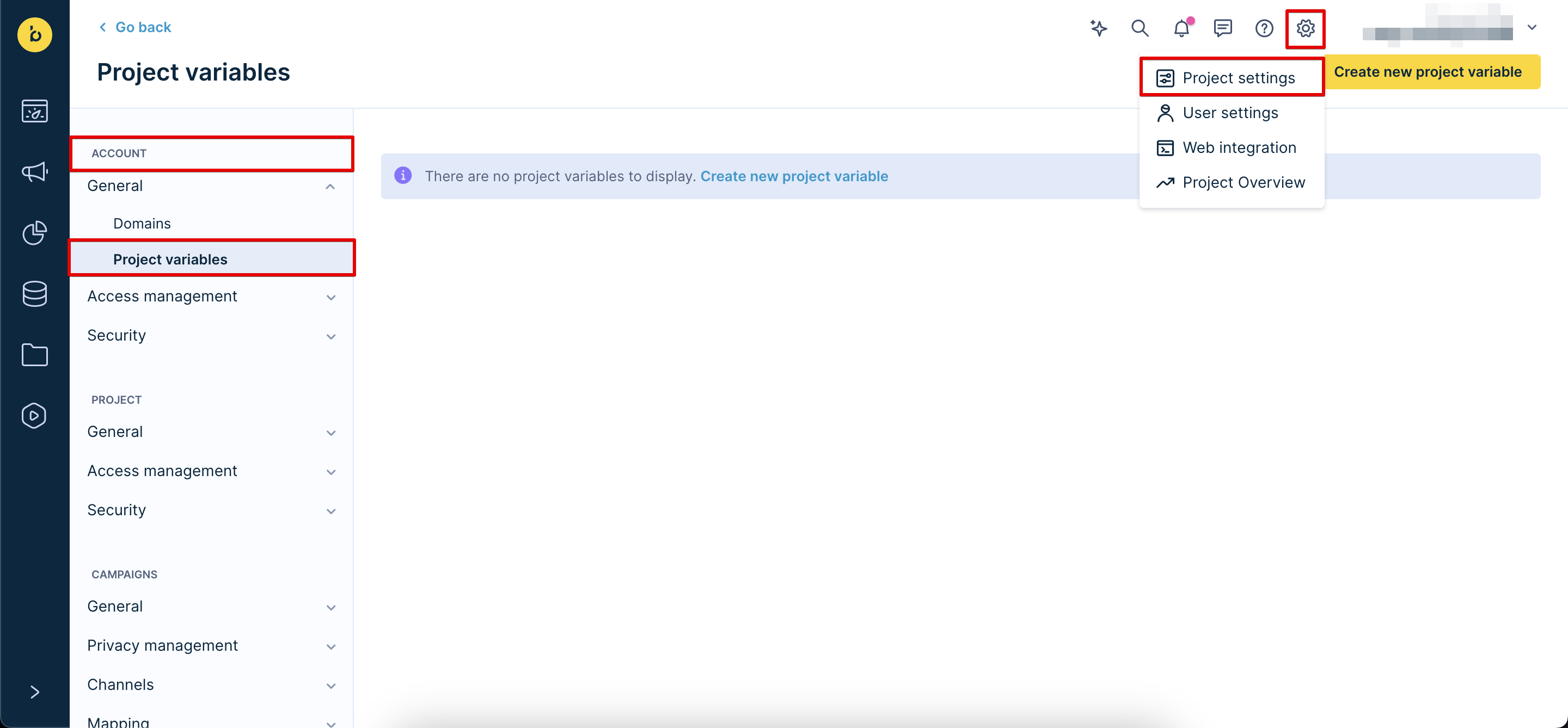
![Image placeholder: screenshot of the Project variables section under Account > General in Project settings]
Caption: The Project variables section under Account > General in Project settings.
To access project-specific variables, go to Project > General.
![Image placeholder: screenshot of the project-specific variables section under Project > General]
Caption: Project-specific variables under Project > General.
Note: For a unified login setup, see Unified project variables.
Create a project variable
To create a new variable, click Create new project variable.
Note: The Account Admin role is required to create project variables. The Project Admin role is sufficient to adjust existing ones.
After clicking the button, the following fields appear:
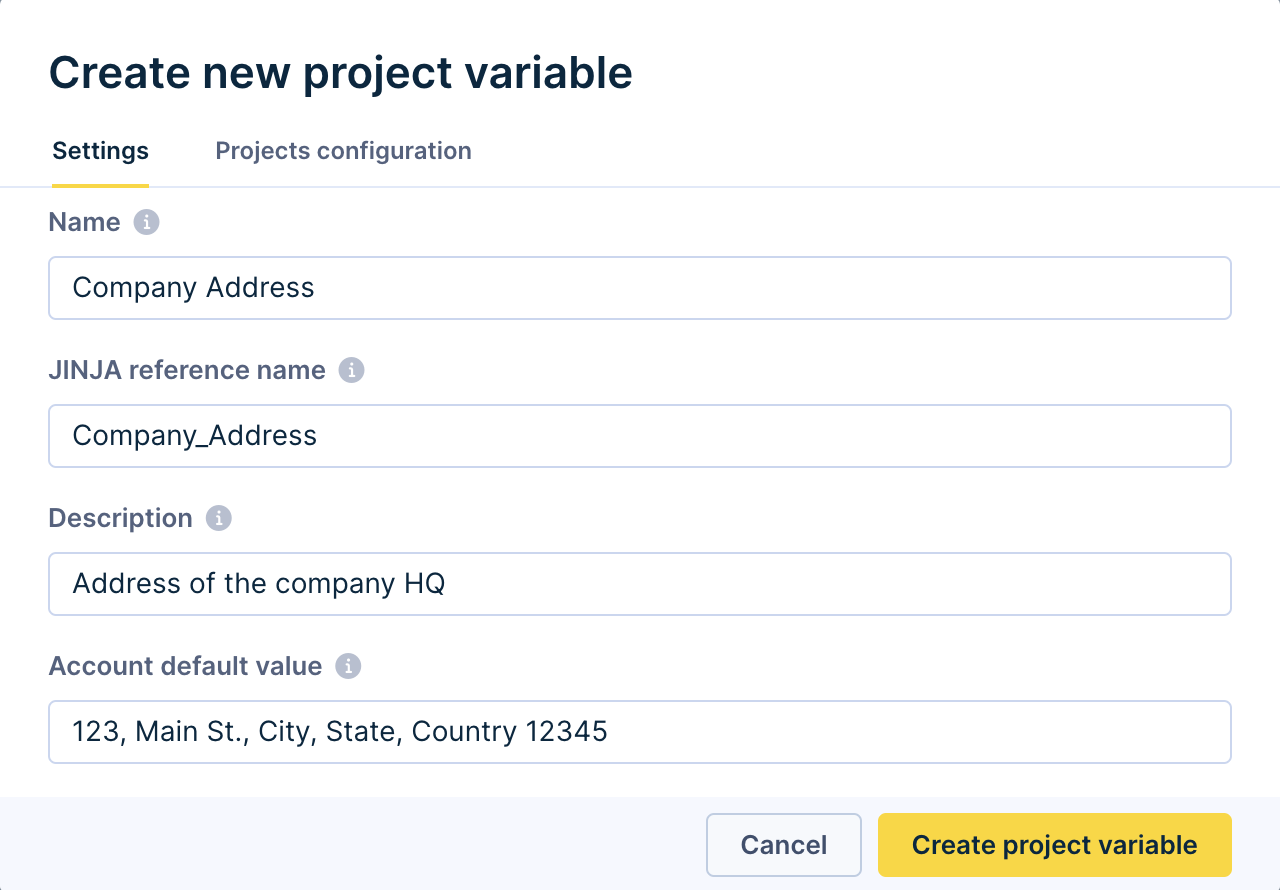
![Image placeholder: screenshot of the new project variable creation form showing Name, Jinja reference name, Description, and Account default value fields]
Caption: The project variable creation form.
- Name: The name by which you recognize this variable.
- Jinja reference name: The variable name used in Jinja code. Only alphanumeric characters are allowed.
- Description: The description shown when selecting a variable.
- Account default value: The value shown in all projects in the account unless a project-level value is defined.
To set different values for specific projects, go to Project configuration > + Add project. This is useful when values differ across company branches, for example different addresses for different locations.
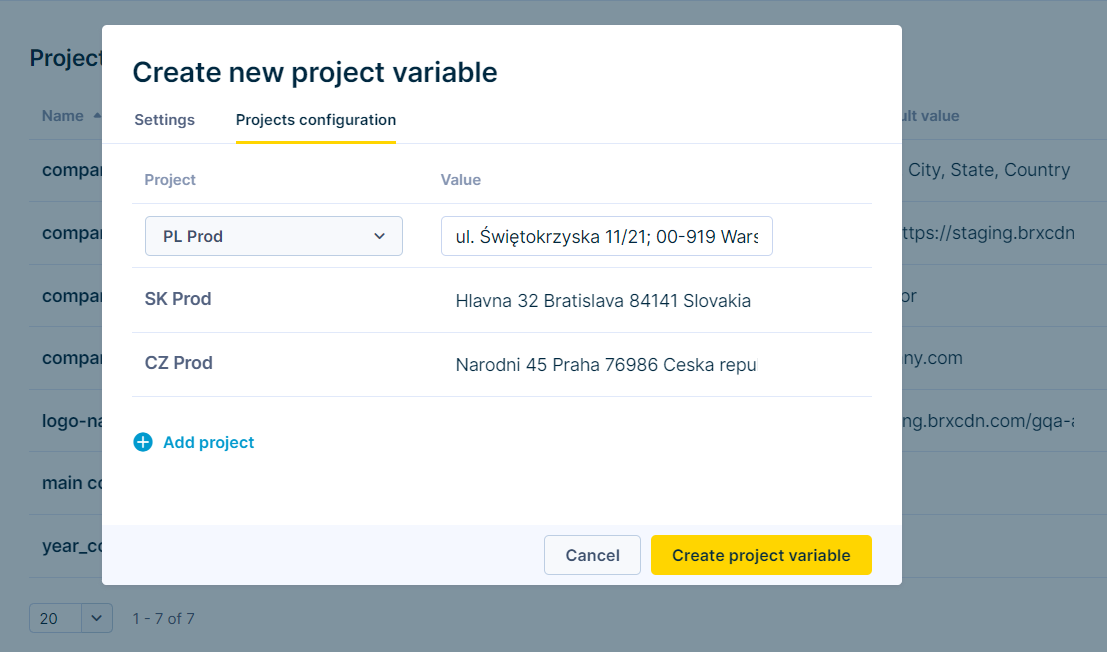
![Image placeholder: screenshot of the project-specific value configuration showing different values for different projects]
Caption: Setting different values for specific projects in Project configuration.
Edit project variables
You can edit project variables at both the account and project levels. Click Edit to open the edit modal.
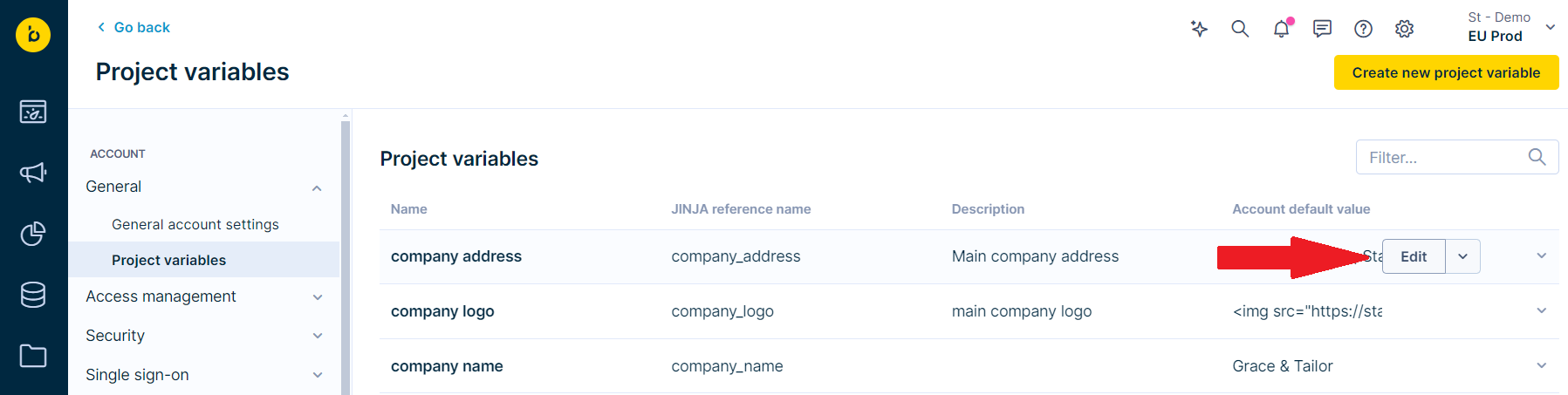
![Image placeholder: screenshot of the project variable edit modal at account level]
Caption: The project variable edit modal at account level.
- At the account level, you can edit values for all projects.
- At the project level, you can edit values for specific projects only.
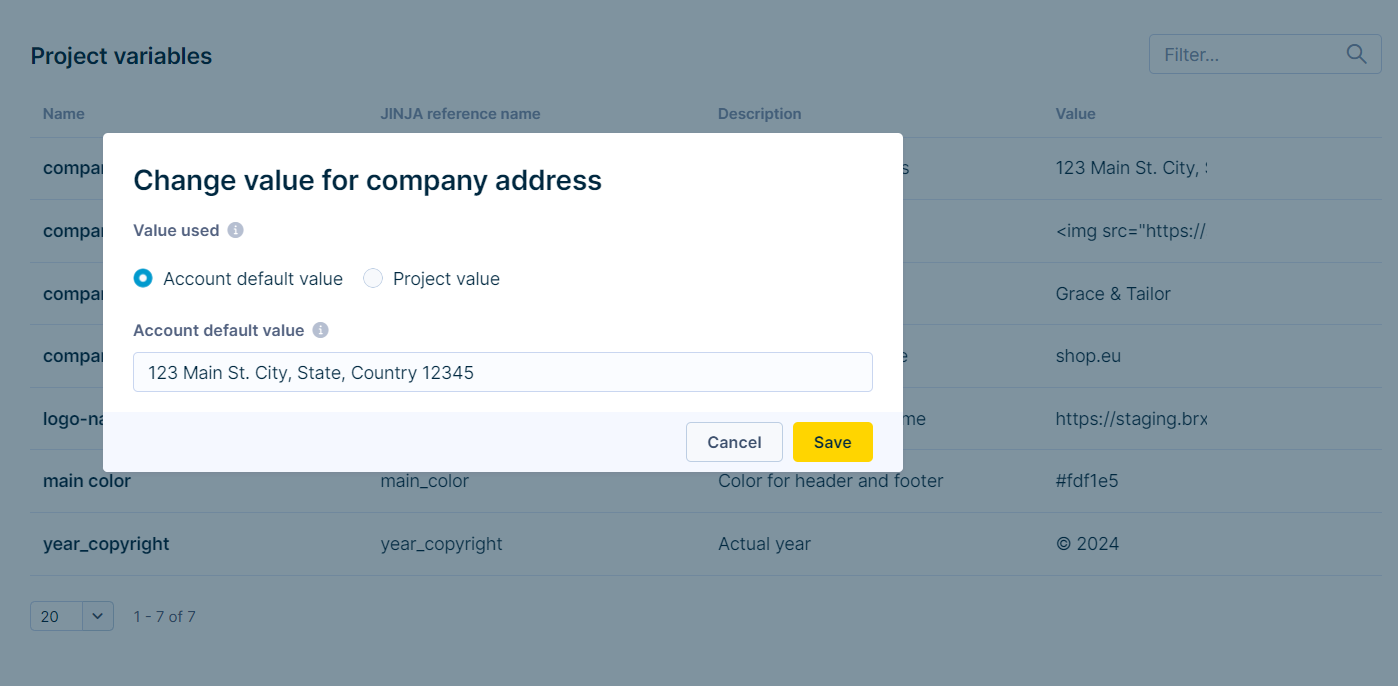
![Image placeholder: screenshot of the project variable edit modal at project level]
Caption: The project variable edit modal at project level.
Note: You can reset a project value to its default from the project level only. At the account level, you can only change values to different values.
Note: You can delete project variables at the account level. New variables cannot share the same name or Jinja reference name as an existing or previously deleted variable.
Use project variables
You can reference project variables in Jinja using the Jinja reference name. Insert {{project_variables.JINJA reference name}} anywhere in Bloomreach that accepts a Jinja input. For example: {{project_variables.Company_Address}}.
Project variables are also accessible as personalization tags in the email editor.

![Image placeholder: screenshot of project variables appearing as personalization tags in the email editor]
Caption: Project variables available as personalization tags in the email editor.
Alternatively, you can insert them using the personalization tab.
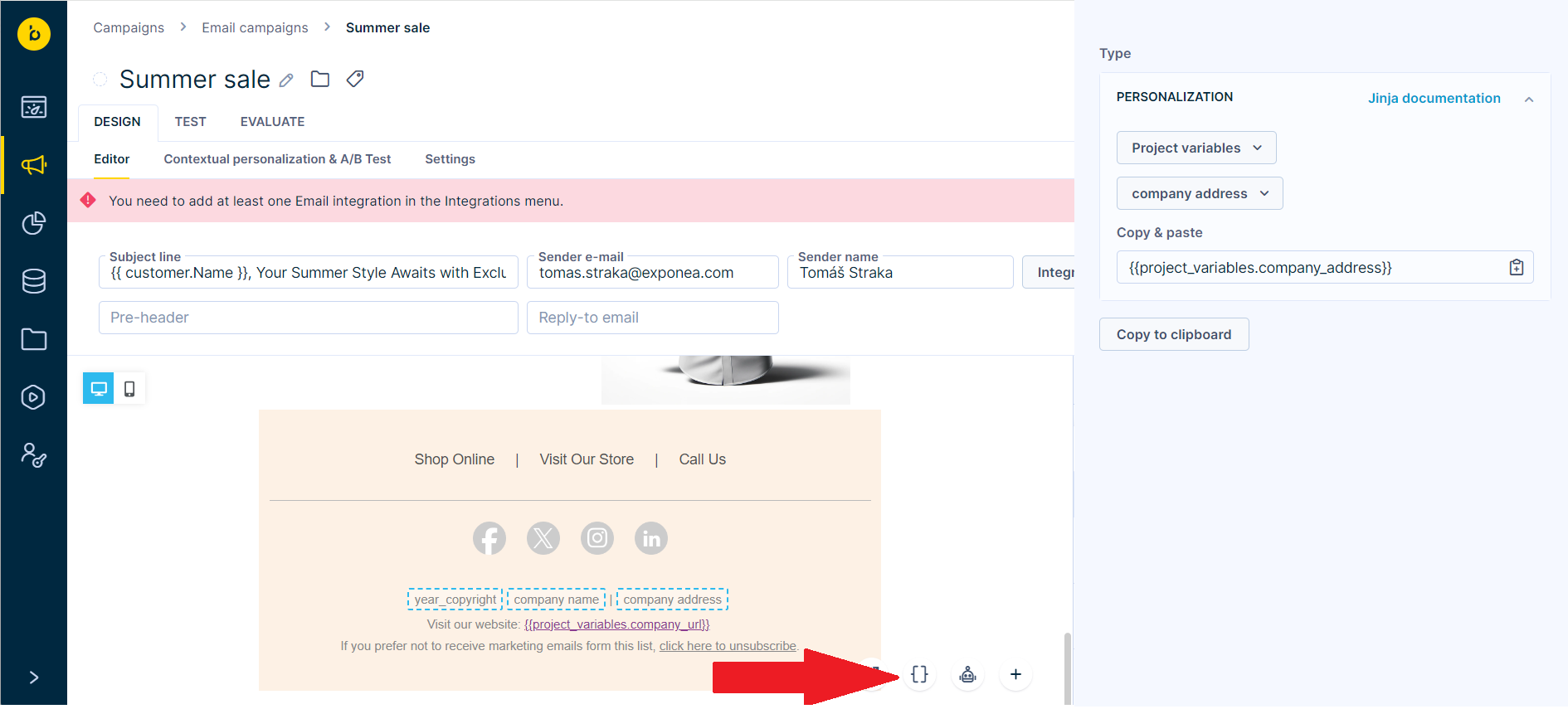
![Image placeholder: screenshot of the personalization tab showing project variables]
Caption: Inserting project variables using the personalization tab.
Limitations
- A maximum of 100 project variables per account.
- A maximum of 1,000 characters per value.
- The Jinja slug allows only alphanumeric characters and
_(underscore). - The Jinja slug must start with a letter.
- Two variables cannot share the same name or Jinja slug.
- If you delete a project variable, a new one cannot use the same name.
Project variables allow project-wide settings to be shared across all definitions where they are used. You can manage them from one place, and changes are automatically applied. This can be used to quickly change some common texts like company address, year, or logo URL.
Project variables can help you:
- Share common settings across scenarios in multiple projects
- Reduce manual work when you copy scenarios across projects
- Speed up project-wide changes in scenarios
Unified loginFor unified login setup, refer to the Unified project variables page.
How does it work?
Go to your Project settings > Account > General > Project variables.
A similar section can be found under Project > General for project-specific variables.
Create a new project variable
To create a new variable, click Create new project variable.
NoteAccount Admin role is required to set up project variables.
Project Admin role is sufficient to adjust existing project variables.
After clicking the button, the following fields will show up:
Name: The name by which you recognize this variable.
Jinja reference name: Variable name used in Jinja code. Only alphanumeric characters are allowed.
Description: You will see this description when selecting a variable.
Account default value: Values shown in all projects with the account unless the value is defined on the project level.
To set different values for specific projects, go to Project configuration > + Add project. In this case, the values for the address are different for different company branches.
Edit project variables
You can edit project variables at both the Account and Project levels.
Click on Edit and a new modal will be displayed. There is a similar modal for account-level editing as for project variable creation.
- On Account level, you can edit values for all projects.
- On Project level, only values for specific projects can be edited.
NoteYou can reset the project value to default from project level management only. On account level the value can be only changed to different values.
NoteYou can also delete Project variables on account level. New variables, however, cannot have the same name or Jinja reference name as an existing or previously deleted variable.
Using project variables
You can use Jinja to reference project variables using the Jinja reference name.
You can insert {{project_variables.JINJA reference name}} anywhere in Bloomreach Engagement with a Jinja input. For example, {{project_variables.Company_Address}}.
Project variables are accessible as Personalization tags in the Email editor.
Alternatively, you can use the personalization tab.
Limitations
- Maximum of 100 project variables per account.
- Maximum of 1000 characters as a value.
- The Jinja slug allows only alphanumeric characters and _ (underscore).
- The Jinja slug must start with a letter.
- You cannot have two variables with the same name or Jinja slug.
- If you delete a project variable, the new one cannot have the same name.
Updated 7 days ago
