

Custom integrations
You can integrate alsmot any third-party application with Bloomreach using Web tracking, Mobile SDK, Omniconnect, Rest API, or Imports.
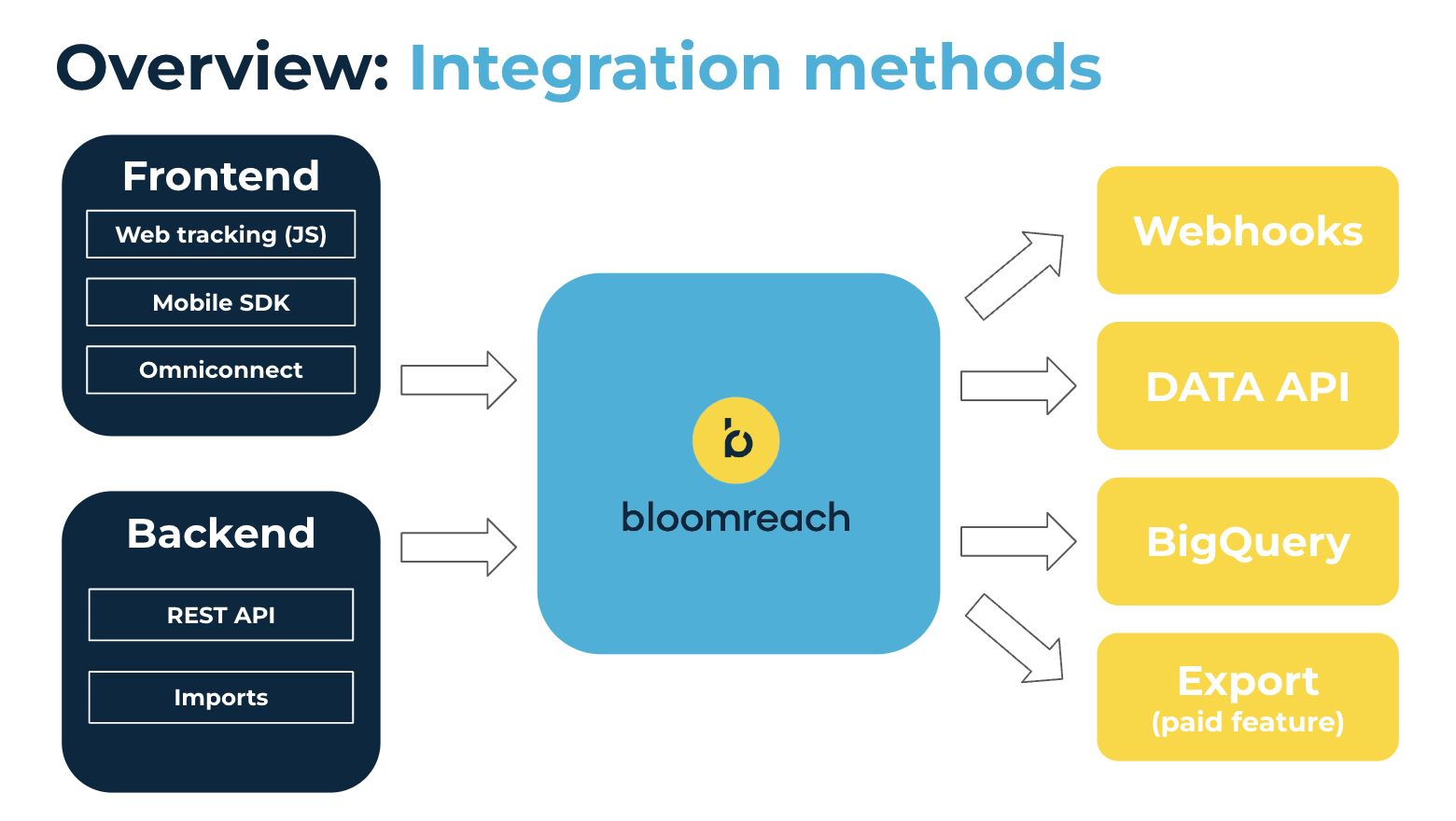
Data flow in Bloomreach — from incoming data to outgoing data to other applications.
Integrations fall into 2 categories based on how data moves:
- Push integrations: Your application sends data to Bloomreach.
- Pull integrations: Bloomreach requests and collects data from an external source.
Send data to Bloomreach
Push — front-end
Front-end integrations collect customer data in real time as they interact with your application.
| Characteristic | Detail |
|---|---|
| Accuracy | ~90% correct |
| Reliability | Changes to your website can break the data flow |
| Setup | Easy to implement, faster time to value |
| Methods | JavaScript SDK, Mobile SDK, Data API (public) |
The following front-end integration methods are available:
- Web tracking: An efficient, easy-to-deploy method for collecting user data. Deployed using a JavaScript initiation snippet that enables communication with Bloomreach.
- Mobile SDK: Similar to web tracking, but enables user tracking in native mobile applications on iOS and Android.
- Omniconnect: A simple solution for integrating with any third-party platform using Webhooks and a JavaScript transformation function.
ImportantFront-end data can contain minor flaws. Any change to the web environment where tracking runs may break the data flow.
Push — back-end
Back-end integrations collect data directly from your application, bypassing the browser or device.
| Characteristic | Detail |
|---|---|
| Accuracy | ~99.5% correct |
| Reliability | Data comes from internal sources — more reliable (1:1) |
| Setup | More complex to implement (for example, time frame considerations) |
| Methods | Data API (public and private) |
REST API: Enables standard communication between 2 applications over a secure channel.
Back-end integrations are typically slower to set up than front-end integrations, but produce more consistent and reliable data.
Pull — imports
Manual imports let you bring data directly into Bloomreach from a file. Supported import types include customers, catalogs, and historical orders. Supported file types include .xls and .csv.
Imports: The primary manual method for getting data into Bloomreach. Easy to set up using the most common file formats.
ImportantBloomreach can only analyze data that is accurate and complete. It doesn't perform data validation or cleaning, so verify the quality of your data before each import.
Pull — integrations
Bloomreach can also pull data automatically from external storage sources:
- File storage: Amazon S3, GCP Storage, BigQuery, HTTPS (URL)
- Databases: MS Azure, SQL, MySQL, PostgreSQL
NoteBloomreach periodically runs automatic health checks on configured integrations to confirm the connection is still valid. If your source uses infrastructure that auto-suspends when idle, these checks can prevent that suspension and add to your costs. See the specific integration's documentation for details.
Export data from Bloomreach
- Data API: Export smaller sets of customer data—typically single-customer access—using the export, get, and retrieve API endpoints.
- Loomi BigQuery: Automated daily exports of all data to a dedicated read-only BigQuery project.
- Exports: Export customer properties and events. Not suitable for full data backups.
- Webhooks: Send HTTPS requests (GET, POST, and others) to any URL, enabling data sharing between Bloomreach and other web services.
Updated about 2 months ago